
THz Raman spectroscopy as easy as 1...2...3!
Introduction
THz Raman is a unique way to extend the already powerful capabilities of Raman spectroscopy for chemical monitoring into the spectral region that also provides powerful information on physical properties associated with fine-tuning physical properties of products or following phase transformation, drying or crystallization processes.
A THz Raman analyzer consists of three basic components:
1. Light source (laser)
2. Detection module (spectrometer)
3. A THz Raman probe and accessories (interface)
Our DIY THz Raman kits give you the flexibility to configure a Raman system with different options for each of these components so that you can optimize the system for your specific application.
Ready to Design?
Use the sections below to explore our options for the 3 key components of your Low Frequency Raman system.
THz Raman DIY Laser
Why do we recommend a 785 nm laser for your DIY THz Raman system?
- Lower fluorescence
- Excellent resolution
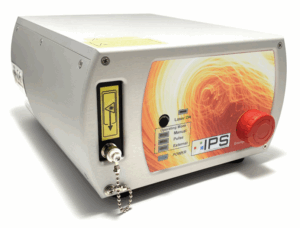
We offer our L-Type 785 nm laser module as standard for the DIY Low Frequency Raman kits. The L-type laser module provides tight control of the current and temperature of the laser to ensure the high degree of laser wavelength stability required for THz Raman applications. The L-type module connects to your computer to provide full software control of your laser.
Looking for another wavelength? Contact us at the link on the bottom of this page.
Spectrometer Tiers
Why is the choice of the detection module important?
The second decision in designing your DIY THz Raman system is choosing the spectrometer performance tier. The data quality of Raman spectra, often reported as the signal-to-noise (SNR), is greatly influenced by the choice of the detection module and its characteristics.
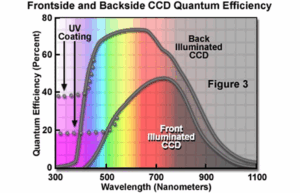
We offer both our Professional Tier and Research-Grade Tier spectrometers as options for our DIY THz Raman system. Both tiers offer the same high throughput levels. The Research-Grade Tier offers deeper detector cooling for lower noise in your data, as shown in the chart below on the right.

Want to learn more about detector module performance? Click the button below to read our Technical Note.
Click here to learn about choosing a spectrometer tier for your DIY THz Raman system.
Probe and Accessories
Why is the choice of the THz Raman probe and Accessories important?
The THz Raman probe is a specialized design that provides the ability to measure to within 5 cm-1 of the laser line, allowing you to use the full extent of the THz Raman spectrum.

Applications for Low Frequency Raman
The physical properties of many compounds depends on differences in their physical state. Polymorphs are an excellent example of this, and play an important role in minerology, materials science, food and beverage, and pharmaceuticals. Polymorphism describes different physical forms of materials, not chemical structure changes.Low-frequency (THz) Raman provides a direct, non-destructive means to measure and help in the optimization and quality control of these physical property differences.
Polymorph Identification in Pharmaceuticals
Many active pharmaceutical ingredients (APIs) exhibit polymorphism, where different forms or molecular structures of a compound can dramatically affect the efficacy, stability and bio-availability of the drug. These structural changes may occur during various stages of formulation, storage, packaging and handling. Consequently, rapid and reliable identification of polymorphs during the development, manufacturing, and quality assurance process is critical in pharmaceutical manufacturing.
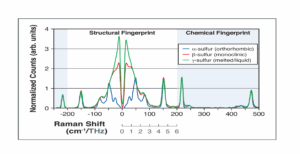
THz Raman spectroscopy extends the range of traditional Raman spectroscopy to the terahertz/low frequency regime, where differentiation of inter- and intra-molecular structures can be clearly seen.
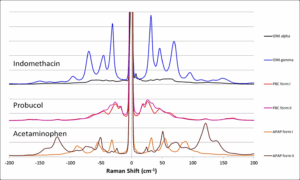
Our DIY THz Raman systems provide fast, unambiguous differentiation of polymorphs, while preserving the complete Raman “fingerprint region” for chemical identification.
Materials Science
Measurement and control of reactions, crystallization rates and/or amorphous states is increasingly important across the chemical, pharmaceutical and electronics industries. Clear, unambiguous determination of material structure (such as polymorphs), degree of crystallinity, and phase is essential to chemical process development, formulation, stability testing and material characterization. As materials change from disordered to highly ordered (e.g. amorphous to crystalline), the low frequency bands shift and become sharper.
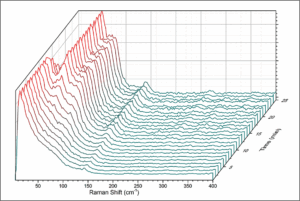
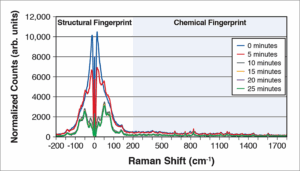
With up to 10X stronger signals than standard Raman, THz-Raman systems provide fast, unambiguous real-time measurement of crystallization and phase characteristics.
Explosives, Drugs, and HazMat
Today’s forward-deployed warfighter and security professionals need to rapidly and reliably identify various compounds or residues found in the field to distinguish between inert materials and home-made explosive (HME) compounds. Forensic experts need data relating to ingredient sources, contaminants and methods of manufacture, as well as insights into the formulation and storage environment, which can reveal clues about where and how it was made.
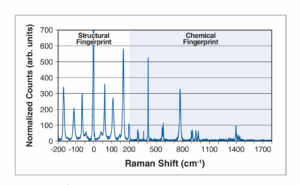
Low-frequency/ THz-Raman analysis can identify and differentiate synthetic pathways, ingredients, and formulations, as well as reveal changes relating to environment and storage (e.g. heat, humidity). These can leave behind telltale “signatures” or “fingerprints” in the molecular structure that help the forensic specialist in narrowing or accelerating their search for clues.
Need Help Getting Started?
Try our pre-configured Low-frequency Raman DIY Kit, which consists of:
1. 785 nm L-type laser module
2. Custom, professional tier Exemplar T spectrometer
3. THz Raman probe
Our pre-configured Low-frequency Raman DIY kit provides an ideal entry point into the world of low-frequency, or THz, Raman measurements. This kit allows measurements as close as 5 cm-1 to the laser line and provides simultaneous data for the THz Stokes and anti-Stokes regions.
Build Your Own Low Frequency System
Reach out to connect with an expert and start building an optimized system today!
Contact Us